Maths 2
Mines-PontsMP2026
Rédigé par IA, non vérifié
Signaler une erreur# Mines-Ponts MP — Maths 2 2026 · Corrigé brut
*Corrigé rédigé par IA (La Belle Copie), non officiel. Signalez toute erreur.*
**Autour de $\mathrm{O}_n(\mathbb{R})$ et $\mathrm{SL}_n(\mathbb{R})$.** Durée 4 h, calculatrice et tout dispositif électronique interdits. 30 questions.
**Conventions.** $n\ge 2$, $E=\mathbb{R}^n$ muni du produit scalaire canonique et de la norme euclidienne $\|\cdot\|$. On munit $\mathcal{M}_n(\mathbb{R})$ du produit scalaire $\langle A,B\rangle=\operatorname{tr}(A^\top B)=\sum_{i,j}a_{ij}b_{ij}$ et de la norme associée $\|A\|$, de sorte que $g(M)=\|M\|^2$. Par l'inégalité de Cauchy-Schwarz appliquée à chaque coefficient $(AB)_{ij}=\sum_k a_{ik}b_{kj}$, on a $\|AB\|\le\|A\|\,\|B\|$, et de même $\|AX\|\le\|A\|\,\|X\|$ pour $X\in\mathbb{C}^n$ (norme hermitienne canonique $\|X\|^2=\sum|x_k|^2$, la majoration $|\sum_k a_{ik}x_k|^2\le(\sum_k a_{ik}^2)(\sum_k|x_k|^2)$ restant valable). On note $\mathcal{A}_n(\mathbb{R})$ l'ensemble des matrices antisymétriques.
---
## I. Quelques propriétés de $\mathrm{O}_n(\mathbb{R})$
### Question 1
$\chi_{R_\theta}=X^2-2\cos(\theta)X+1$, de discriminant $4\cos^2\theta-4=-4\sin^2\theta$.
- Si $\sin\theta=0$ ($\theta\in\pi\mathbb{Z}$) : $R_\theta=\cos(\theta)I_2=\pm I_2$ est diagonale, donc diagonalisable sur $\mathbb{R}$ et sur $\mathbb{C}$.
- Si $\sin\theta\neq0$ : le discriminant est $<0$, $\chi_{R_\theta}$ n'a pas de racine réelle, donc $R_\theta$ n'a aucune valeur propre réelle ; une matrice diagonalisable sur $\mathbb{R}$ est semblable à une matrice diagonale réelle dont les coefficients sont des valeurs propres réelles, donc $R_\theta$ n'est pas diagonalisable sur $\mathbb{R}$. Sur $\mathbb{C}$, $\chi_{R_\theta}$ a les deux racines $e^{i\theta}$ et $e^{-i\theta}$ (somme $2\cos\theta$, produit $1$), distinctes puisque $e^{i\theta}-e^{-i\theta}=2i\sin\theta\neq0$ : une matrice de taille 2 ayant deux valeurs propres distinctes est diagonalisable, $R_\theta\sim\operatorname{diag}(e^{i\theta},e^{-i\theta})$.
**$R_\theta$ est toujours diagonalisable sur $\mathbb{C}$ ; elle est diagonalisable sur $\mathbb{R}$ si et seulement si $\theta\in\pi\mathbb{Z}$, c'est-à-dire $R_\theta=\pm I_2$.**
### Question 2
*Inclusion $\supset$.* $R_\theta^\top R_\theta=\begin{pmatrix}\cos^2\theta+\sin^2\theta&0\\0&\sin^2\theta+\cos^2\theta\end{pmatrix}=I_2$ et $\det R_\theta=\cos^2\theta+\sin^2\theta=1$, donc $R_\theta\in\mathrm{SO}_2(\mathbb{R})$.
*Inclusion $\subset$.* Soit $M=\begin{pmatrix}a&b\\c&d\end{pmatrix}\in\mathrm{SO}_2(\mathbb{R})$, de colonnes $C_1=(a,c)$, $C_2=(b,d)$. La relation $M^\top M=I_2$ signifie que $(C_1,C_2)$ est orthonormée : $a^2+c^2=1$, $b^2+d^2=1$, $ab+cd=0$. Comme $a^2+c^2=1$, il existe $\theta\in\mathbb{R}$ tel que $a=\cos\theta$, $c=\sin\theta$ (paramétrage du cercle unité). Le vecteur $C_2$ appartient à $C_1^\perp$, droite de $\mathbb{R}^2$ dirigée par le vecteur unitaire $u=(-\sin\theta,\cos\theta)$ ; étant unitaire, $C_2=\pm u$. Si $C_2=-u$, alors $M=\begin{pmatrix}\cos\theta&\sin\theta\\\sin\theta&-\cos\theta\end{pmatrix}$ et $\det M=-1$, exclu. Donc $C_2=u$ et $M=R_\theta$.
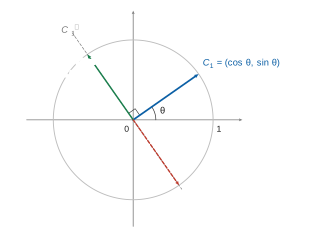
$$\boxed{\mathrm{SO}_2(\mathbb{R})=\{R_\theta,\ \theta\in\mathbb{R}\}}$$
### Question 3
*Compacité.* $f:M\mapsto M^\top M$ est continue (coefficients polynomiaux), donc $\mathrm{O}_n(\mathbb{R})=f^{-1}(\{I_n\})$ est fermé. Pour $M\in\mathrm{O}_n(\mathbb{R})$, $\|M\|^2=\operatorname{tr}(M^\top M)=n$ : $\mathrm{O}_n(\mathbb{R})$ est borné. Fermé et borné dans l'espace $\mathcal{M}_n(\mathbb{R})$ de dimension finie, **$\mathrm{O}_n(\mathbb{R})$ est compact**.
*Non-connexité par arcs.* Pour $M\in\mathrm{O}_n(\mathbb{R})$, $(\det M)^2=\det(M^\top M)=1$, donc $\det M\in\{-1,1\}$. On a $I_n\in\mathrm{O}_n(\mathbb{R})$ (déterminant $1$) et $S=\operatorname{diag}(-1,1,\dots,1)\in\mathrm{O}_n(\mathbb{R})$ (car $S^\top S=S^2=I_n$, déterminant $-1$). S'il existait un chemin continu $\gamma:[0,1]\to\mathrm{O}_n(\mathbb{R})$ de $I_n$ à $S$, la fonction réelle continue $\det\circ\gamma$ passerait de $1$ à $-1$ et s'annulerait par le théorème des valeurs intermédiaires, ce qui contredit $\det(\mathrm{O}_n(\mathbb{R}))\subset\{-1,1\}$. **$\mathrm{O}_n(\mathbb{R})$ n'est pas connexe par arcs.**
### Question 4
Il suffit de joindre tout $M\in\mathrm{SO}_n(\mathbb{R})$ à $I_n$ par un chemin continu à valeurs dans $\mathrm{SO}_n(\mathbb{R})$ : deux éléments quelconques sont alors reliés en passant par $I_n$ (concaténation de chemins). On le montre par récurrence sur $n\ge2$.
*Cas $n=2$.* Par la question 2, $M=R_\theta$ ; le chemin $t\mapsto R_{(1-t)\theta}$, $t\in[0,1]$, est continu, à valeurs dans $\mathrm{SO}_2(\mathbb{R})$, et va de $M$ à $I_2$.
*Hérédité.* Soit $n\ge3$, la propriété étant acquise en dimension $n-1$. Soit $M\in\mathrm{SO}_n(\mathbb{R})$ et $y=Me_1$, unitaire.
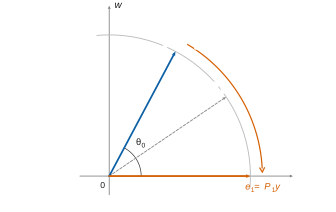
1. *On ramène $y$ sur $e_1$.* Choisissons un vecteur unitaire $w\perp e_1$ et $\theta_0\in[0,\pi]$ tels que $y=\cos(\theta_0)e_1+\sin(\theta_0)w$ : si $y\neq\pm e_1$, $w=\dfrac{y-\langle y,e_1\rangle e_1}{\|y-\langle y,e_1\rangle e_1\|}$ et $\cos\theta_0=\langle y,e_1\rangle$, $\sin\theta_0=\|y-\langle y,e_1\rangle e_1\|$ ; si $y=e_1$, $\theta_0=0$ et $w$ quelconque ; si $y=-e_1$, $\theta_0=\pi$ et $w$ quelconque. Complétons $(e_1,w)$ en une base orthonormée de $E$, de matrice de passage $U\in\mathrm{O}_n(\mathbb{R})$, et posons
$$P_t=U\begin{pmatrix}R_{-t\theta_0}&0\\0&I_{n-2}\end{pmatrix}U^{-1},\qquad t\in[0,1].$$
$P_t$ est orthogonale (produit de matrices orthogonales) de déterminant $\det R_{-t\theta_0}=1$, $t\mapsto P_t$ est continue, $P_0=I_n$, et, puisque $U^{-1}y=(\cos\theta_0,\sin\theta_0,0,\dots,0)^\top$ et $R_{-\theta_0}(\cos\theta_0,\sin\theta_0)^\top=(1,0)^\top$, on a $P_1y=e_1$. Le chemin $t\mapsto P_tM$ est continu dans $\mathrm{SO}_n(\mathbb{R})$ et joint $M$ à $M'=P_1M$, qui vérifie $M'e_1=e_1$.
2. *On descend en dimension $n-1$.* $M'$ fixe $e_1$ ; pour $x\perp e_1$, $\langle M'x,e_1\rangle=\langle M'x,M'e_1\rangle=\langle x,e_1\rangle=0$, donc $M'$ stabilise $e_1^\perp=\operatorname{Vect}(e_2,\dots,e_n)$ et $M'=\begin{pmatrix}1&0\\0&M''\end{pmatrix}$, avec $M''^\top M''=I_{n-1}$ et $\det M''=\det M'=1$. Par hypothèse de récurrence, un chemin $\Gamma$ joint $M''$ à $I_{n-1}$ dans $\mathrm{SO}_{n-1}(\mathbb{R})$, et $t\mapsto\begin{pmatrix}1&0\\0&\Gamma(t)\end{pmatrix}$ joint $M'$ à $I_n$ dans $\mathrm{SO}_n(\mathbb{R})$.
Par concaténation, $M$ est joint à $I_n$ dans $\mathrm{SO}_n(\mathbb{R})$. **$\mathrm{SO}_n(\mathbb{R})$ est connexe par arcs.**
### Question 5
Soit $H$ un sous-groupe de $\mathrm{O}_n(\mathbb{R})$ contenant $\mathrm{SO}_n(\mathbb{R})$. Si $H\subset\mathrm{SO}_n(\mathbb{R})$, alors $H=\mathrm{SO}_n(\mathbb{R})$. Sinon, il existe $A\in H$ avec $\det A=-1$. Soit $B\in\mathrm{O}_n(\mathbb{R})$ : si $\det B=1$, $B\in\mathrm{SO}_n(\mathbb{R})\subset H$ ; si $\det B=-1$, alors $A^{-1}B\in\mathrm{O}_n(\mathbb{R})$ et $\det(A^{-1}B)=1$, donc $A^{-1}B\in\mathrm{SO}_n(\mathbb{R})\subset H$, puis $B=A(A^{-1}B)\in H$. Ainsi $\mathrm{O}_n(\mathbb{R})\subset H\subset\mathrm{O}_n(\mathbb{R})$.
**$H=\mathrm{SO}_n(\mathbb{R})$ ou $H=\mathrm{O}_n(\mathbb{R})$.**
### Question 6
*$\mathrm{GL}_2$.* $\det Z_2=U-V$ avec $U=Y_{1,1}Y_{2,2}$ et $V=Y_{1,2}Y_{2,1}$, variables à valeurs dans $\{0,1\}$, indépendantes (fonctions de familles disjointes de variables indépendantes), avec $P(U=1)=P(V=1)=p^2$. Alors $Z_2\in\mathrm{GL}_2(\mathbb{R})\iff U\neq V$, d'où
$$\boxed{P(Z_2\in\mathrm{GL}_2(\mathbb{R}))=P(U=1)P(V=0)+P(U=0)P(V=1)=2p^2(1-p^2).}$$
*$\mathrm{O}_n$.* Soit $A$ à coefficients dans $\{0,1\}$ et orthogonale. Chaque colonne $C_j$ vérifie $\|C_j\|^2=\sum_i a_{ij}^2=\sum_i a_{ij}=1$ : elle contient exactement un coefficient $1$, en une ligne notée $\sigma(j)$. Pour $j\neq j'$, $\langle C_j,C_{j'}\rangle=\sum_i a_{ij}a_{ij'}=0$ avec des termes positifs, donc $\sigma(j)\neq\sigma(j')$. Ainsi $\sigma$ est injective, donc bijective, et $A$ est la matrice de permutation $P_\sigma$. Réciproquement, toute matrice de permutation est orthogonale (colonnes formant une permutation de la base canonique). Les événements $\{Z_n=P_\sigma\}$ sont deux à deux incompatibles et, par indépendance des $n^2$ coefficients, $P(Z_n=P_\sigma)=p^n(1-p)^{n^2-n}$. Donc
$$\boxed{P(Z_n\in\mathrm{O}_n(\mathbb{R}))=n!\,p^n(1-p)^{n^2-n}.}$$
*$\mathrm{SO}_n$.* $\det P_\sigma=\varepsilon(\sigma)$ ; $P_\sigma\in\mathrm{SO}_n(\mathbb{R})$ si et seulement si $\sigma$ est paire. Pour $n\ge2$, la signature est un morphisme surjectif de $\mathfrak{S}_n$ sur $\{-1,1\}$, donc $\mathfrak{A}_n$ a $n!/2$ éléments, et
$$\boxed{P(Z_n\in\mathrm{SO}_n(\mathbb{R}))=\frac{n!}{2}\,p^n(1-p)^{n^2-n}.}$$
### Question 7
Pour $u\in E$ non nul, la réflexion d'hyperplan $u^\perp$ est $s_u:v\mapsto v-2\dfrac{\langle v,u\rangle}{\|u\|^2}u$ ; sa matrice dans la base canonique est une matrice de réflexion (orthogonale, de déterminant $-1$).
- Si $x\neq y$, posons $u=x-y\neq0$. Comme $\|x\|=\|y\|$, $\|u\|^2=\|x\|^2-2\langle x,y\rangle+\|y\|^2=2(\|x\|^2-\langle x,y\rangle)=2\langle x,u\rangle$, donc $s_u(x)=x-u=y$.
- Si $x=y$, comme $n\ge2$ il existe $u\neq0$ orthogonal à $x$ ($x^\perp$ est de dimension au moins $n-1\ge1$) ; alors $s_u(x)=x=y$.
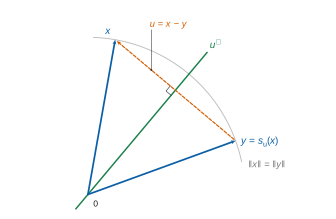
**Dans les deux cas, la matrice $A$ de $s_u$ est une matrice de réflexion telle que $Ax=y$.**
### Question 8
Soient $G\in\mathcal{G}$, $x$ unitaire et $\lambda=\|Gx\|$ ; $\lambda>0$ car $G$ est inversible et $x\neq0$.
*Cas $p=1$.* $\|\lambda x\|=\lambda=\|Gx\|$ ; par la question 7, il existe une matrice de réflexion $A$ avec $A(Gx)=\lambda x$. Comme $A\in\mathrm{O}_n(\mathbb{R})\subset\mathcal{G}$ et que $\mathcal{G}$ est un groupe, $G_1:=AG\in\mathcal{G}$ et $G_1x=\lambda x$.
*Cas général.* Posons $G_p=G_1^{\,p}\in\mathcal{G}$ pour $p\in\mathbb{Z}$ (stabilité d'un groupe par puissances entières). Par récurrence, $G_1^{\,p}x=\lambda^px$ pour $p\in\mathbb{N}$ ; de $G_1x=\lambda x$ et $\lambda\neq0$ on tire $G_1^{-1}x=\lambda^{-1}x$, puis $G_1^{-p}x=\lambda^{-p}x$ pour $p\in\mathbb{N}$. Ainsi
$$\boxed{\forall p\in\mathbb{Z},\quad G_p\in\mathcal{G}\ \text{ et }\ G_px=\|Gx\|^p\,x.}$$
### Question 9
$\mathcal{G}$ est compact donc borné : il existe $C>0$ tel que $\|H\|\le C$ pour tout $H\in\mathcal{G}$. Soient $G\in\mathcal{G}$, $x$ unitaire, $\lambda=\|Gx\|>0$. Pour tout $p\in\mathbb{Z}$, avec $G_p$ de la question 8,
$$\lambda^p=\|G_px\|\le\|G_p\|\,\|x\|\le C.$$
Si $\lambda>1$, $\lambda^p\to+\infty$ quand $p\to+\infty$ ; si $\lambda<1$, $\lambda^p\to+\infty$ quand $p\to-\infty$ : contradiction dans les deux cas. Donc $\|Gx\|=1$ pour tout $x$ unitaire, puis, par homogénéité, $\|Gv\|=\|v\|$ pour tout $v\in E$. Par polarisation ($\langle a,b\rangle=\frac12(\|a+b\|^2-\|a\|^2-\|b\|^2)$), $\langle Ga,Gb\rangle=\langle a,b\rangle$, c'est-à-dire $\langle(G^\top G-I_n)a,b\rangle=0$ pour tous $a,b$ ; avec $b=(G^\top G-I_n)a$, on obtient $G^\top G=I_n$. Donc $\mathcal{G}\subset\mathrm{O}_n(\mathbb{R})$, et l'inclusion réciproque est une hypothèse :
$$\boxed{\mathcal{G}=\mathrm{O}_n(\mathbb{R}).}$$
---
## II. Calcul différentiel sur $\mathrm{O}_n(\mathbb{R})$ et $\mathrm{SL}_n(\mathbb{R})$
### Question 10
Pour $M,H\in\mathcal{M}_n(\mathbb{R})$ :
$$f(M+H)=f(M)+(M^\top H+H^\top M)+H^\top H,$$
où $H\mapsto M^\top H+H^\top M$ est linéaire et $\|H^\top H\|\le\|H^\top\|\,\|H\|=\|H\|^2=o(\|H\|)$. Donc $f$ est différentiable en tout $M$ et
$$\boxed{\mathrm{d}f(M)\cdot H=M^\top H+H^\top M.}$$
L'application $M\mapsto\mathrm{d}f(M)$ est linéaire de $\mathcal{M}_n(\mathbb{R})$ dans $\mathcal{L}(\mathcal{M}_n(\mathbb{R}))$, espace de dimension finie, donc continue : **$f$ est de classe $\mathcal{C}^1$** (ses coefficients sont d'ailleurs polynomiaux).
### Question 11
Soit $H\in T$, associé à $\gamma:\,]-\varepsilon,\varepsilon[\,\to\mathrm{O}_n(\mathbb{R})$ dérivable en $0$, $\gamma(0)=I_n$, $\gamma'(0)=H$. On a $f\circ\gamma=I_n$ (constante). Comme $f$ est différentiable en $I_n$ et $\gamma$ dérivable en $0$, la règle de dérivation le long d'un arc donne
$$0=(f\circ\gamma)'(0)=\mathrm{d}f(I_n)\cdot H=H+H^\top.$$
**Donc $H^\top=-H$ : $T\subset\mathcal{A}_n(\mathbb{R})$.**
### Question 12
*Somme.* Soient $H,K\in T$, d'arcs $\gamma_H,\gamma_K$ ; sur $]-\varepsilon,\varepsilon[$ avec $\varepsilon=\min(\varepsilon_H,\varepsilon_K)$, posons $\gamma=\gamma_H\gamma_K$. Il est à valeurs dans $\mathrm{O}_n(\mathbb{R})$ (groupe), $\gamma(0)=I_n$, et, le produit matriciel étant bilinéaire, $\gamma$ est dérivable en $0$ avec $\gamma'(0)=\gamma_H'(0)\gamma_K(0)+\gamma_H(0)\gamma_K'(0)=H+K$. Donc **$H+K\in T$**.
*Structure d'espace vectoriel.* $0\in T$ (arc constant $I_n$). Pour $H\in T$ et $\lambda\neq0$, $\delta(t)=\gamma_H(\lambda t)$, défini sur $]-\varepsilon/|\lambda|,\varepsilon/|\lambda|[$, est à valeurs dans $\mathrm{O}_n(\mathbb{R})$, $\delta(0)=I_n$, dérivable en $0$ de dérivée $\lambda H$ ; donc $\lambda H\in T$ (et $0\cdot H=0\in T$). **$T$ est un sous-espace vectoriel de $\mathcal{M}_n(\mathbb{R})$**, donc un $\mathbb{R}$-espace vectoriel.
### Question 13
Soit $H\in\mathcal{A}_n(\mathbb{R})$ et $\gamma(t)=\exp(tH)$. Par continuité de la transposition, $\exp(tH)^\top=\exp(tH^\top)=\exp(-tH)$ ; $tH$ et $-tH$ commutent, donc $\gamma(t)^\top\gamma(t)=\exp(-tH)\exp(tH)=\exp(0)=I_n$ : $\gamma$ est à valeurs dans $\mathrm{O}_n(\mathbb{R})$, et $\gamma(0)=I_n$. Enfin, pour $t\neq0$,
$$\Big\|\frac{\gamma(t)-I_n}{t}-H\Big\|\le\frac1{|t|}\sum_{k\ge2}\frac{|t|^k\|H\|^k}{k!}=\frac{e^{|t|\|H\|}-1-|t|\|H\|}{|t|}\xrightarrow[t\to0]{}0,$$
donc $\gamma'(0)=H$ et $H\in T$. Avec la question 11 :
$$\boxed{T=\mathcal{A}_n(\mathbb{R})=\{H\in\mathcal{M}_n(\mathbb{R}),\ H^\top=-H\}.}$$
### Question 14
Pour $t>0$, $D_t=\operatorname{diag}(t,1/t,1,\dots,1)$ (possible car $n\ge2$) vérifie $\det D_t=1$ et
$$g(D_t)=t^2+\frac1{t^2}+(n-2)\xrightarrow[t\to+\infty]{}+\infty.$$
**La restriction de $g$ à $\mathrm{SL}_n(\mathbb{R})$ n'est pas majorée, donc n'a pas de maximum global.**
### Question 15
$g(M)=\sum_{i,j}m_{ij}^2$ et $\det M=\sum_{\sigma\in\mathfrak{S}_n}\varepsilon(\sigma)\prod_i m_{\sigma(i)i}$ sont polynomiales en les coefficients, donc de classe $\mathcal{C}^\infty$, en particulier $\mathcal{C}^1$.
*Gradient de $g$.* $g(M+H)=g(M)+2\langle M,H\rangle+\|H\|^2$ (car $\operatorname{tr}(H^\top M)=\operatorname{tr}(M^\top H)$), et $\|H\|^2=o(\|H\|)$, donc $\mathrm{d}g(M)\cdot H=\langle 2M,H\rangle$ :
$$\boxed{\nabla g(M)=2M.}$$
*Gradient de $\det$.* Développons $\det M$ selon la ligne $i$ : $\det M=\sum_k m_{ik}\operatorname{Com}(M)_{ik}$, où le cofacteur $\operatorname{Com}(M)_{ik}=(-1)^{i+k}\Delta_{ik}(M)$ ne fait intervenir aucun coefficient de la ligne $i$, donc ne dépend pas de $m_{ij}$. Par conséquent $\dfrac{\partial\det}{\partial m_{ij}}(M)=\operatorname{Com}(M)_{ij}$, et
$$\mathrm{d}\det(M)\cdot H=\sum_{i,j}\operatorname{Com}(M)_{ij}h_{ij}=\langle\operatorname{Com}(M),H\rangle,\qquad\boxed{\nabla\det(M)=\operatorname{Com}(M).}$$
### Question 16
$\mathrm{SL}_n(\mathbb{R})$ est l'ensemble des zéros de $h=\det-1$, de classe $\mathcal{C}^1$ sur l'ouvert $\mathcal{M}_n(\mathbb{R})$. Soit $M\in\mathrm{SL}_n(\mathbb{R})$ où $g_{|\mathrm{SL}_n(\mathbb{R})}$ a un extremum local. Comme $M\operatorname{Com}(M)^\top=\det(M)I_n=I_n$, on a $\operatorname{Com}(M)=(M^{-1})^\top\neq0$, donc $\mathrm{d}h(M)\neq0$. Le théorème d'optimisation sous une contrainte donne la colinéarité de $\mathrm{d}g(M)$ et $\mathrm{d}h(M)$, soit $2M=\mu\operatorname{Com}(M)$ pour un $\mu\in\mathbb{R}$ :
$$\boxed{M=\lambda\operatorname{Com}(M),\quad\lambda=\mu/2\in\mathbb{R}.}$$
Alors $M=\lambda(M^{-1})^\top$, d'où $M^\top=\lambda M^{-1}$ et $M^\top M=\lambda I_n$. En prenant la trace, $n\lambda=\|M\|^2>0$ (car $M\neq0$), donc $\lambda>0$ ; en prenant le déterminant, $\lambda^n=(\det M)^2=1$. Comme $\lambda>0$, $\lambda=1$ : $M^\top M=I_n$ et $\det M=1$, **donc $M\in\mathrm{SO}_n(\mathbb{R})$**.
### Question 17
*Existence.* Soit $K=\{M\in\mathrm{SL}_n(\mathbb{R}),\ g(M)\le n\}=\det^{-1}(\{1\})\cap g^{-1}(]-\infty,n])$. Il est fermé (images réciproques de fermés par des applications continues), borné ($\|M\|^2\le n$), non vide ($I_n\in K$), donc compact (dimension finie). La fonction continue $g$ y atteint son minimum en un $M_0$, avec $g(M_0)\le g(I_n)=n$. Pour $M\in\mathrm{SL}_n(\mathbb{R})\setminus K$, $g(M)>n\ge g(M_0)$. Donc $g(M_0)$ est le **minimum global** de $g$ sur $\mathrm{SL}_n(\mathbb{R})$.
*Valeur et points.* Si $M$ réalise ce minimum, c'est un extremum local de $g_{|\mathrm{SL}_n(\mathbb{R})}$, donc $M\in\mathrm{SO}_n(\mathbb{R})$ (question 16) et $g(M)=\operatorname{tr}(I_n)=n$. Réciproquement, tout $M\in\mathrm{SO}_n(\mathbb{R})$ est dans $\mathrm{SL}_n(\mathbb{R})$ et vérifie $g(M)=n$.
$$\boxed{\min_{\mathrm{SL}_n(\mathbb{R})}g=n,\ \text{atteint exactement sur }\mathrm{SO}_n(\mathbb{R}).}$$
---
## III. Morphismes continus de $\mathbb{U}$ dans $\mathrm{GL}_n(\mathbb{R})$
### Question 18
*Sous-groupes bornés de $\mathbb{R}^*$.* Soit $H$ un sous-groupe borné et $x\in H$ ; $x^k\in H$ pour tout $k\in\mathbb{Z}$. Si $|x|>1$, $|x|^k\to+\infty$ ($k\to+\infty$) ; si $|x|<1$, $|x|^{-k}\to+\infty$ : contradiction. Donc $|x|=1$ et $H\subset\{-1,1\}$. Comme $H$ contient $1$, **les sous-groupes bornés de $\mathbb{R}^*$ sont $\{1\}$ et $\{-1,1\}$** (qui sont bien des sous-groupes bornés).
*Conséquence.* $\delta=\det\circ\varphi:\mathbb{U}\to\mathbb{R}^*$ est un morphisme de groupes continu. Son image est un sous-groupe de $\mathbb{R}^*$, compact comme image continue du compact $\mathbb{U}$, donc borné : $\delta(\mathbb{U})\subset\{-1,1\}$. Par ailleurs $\mathbb{U}$ est connexe par arcs (image de $\mathbb{R}$ par $t\mapsto e^{it}$), donc $\delta(\mathbb{U})$ est une partie connexe par arcs de $\mathbb{R}$, c'est-à-dire un intervalle, contenu dans $\{-1,1\}$ et contenant $\delta(1)=1$ : $\delta(\mathbb{U})=\{1\}$.
$$\boxed{\varphi(\mathbb{U})\subset\mathrm{SL}_n(\mathbb{R}).}$$
### Question 19
$K=\varphi(\mathbb{U})$ est compact (image continue d'un compact), donc il existe $C$ tel que $\|A\|\le C$ pour $A\in K$. Soient $z\in\mathbb{U}$, $A=\varphi(z)$, $\lambda\in\mathrm{Sp}_{\mathbb{C}}(A)$ et $X\in\mathbb{C}^n\setminus\{0\}$ tel que $AX=\lambda X$ ; $\lambda\neq0$ car $A$ est inversible. Pour $k\in\mathbb{Z}$, $A^k=\varphi(z^k)\in K$ et $A^kX=\lambda^kX$, donc
$$|\lambda|^k\|X\|=\|A^kX\|\le\|A^k\|\,\|X\|\le C\|X\|,$$
soit $|\lambda|^k\le C$ pour tout $k\in\mathbb{Z}$. Cela impose $|\lambda|=1$ (sinon $|\lambda|^k$ tend vers $+\infty$ en $+\infty$ ou en $-\infty$).
$$\boxed{\mathrm{Sp}_{\mathbb{C}}(\varphi(z))\subset\mathbb{U}.}$$
### Question 20
Pour $x,y\in\mathbb{R}$, $e^{i(x+y)}=e^{ix}e^{iy}$ et $\varphi$ est un morphisme, donc
$$\Psi(x+y)=\varphi(e^{ix}e^{iy})=\varphi(e^{ix})\varphi(e^{iy})=\Psi(x)\Psi(y).$$
On note pour la suite que $\Psi$ est continue (composée), que $\Psi(0)=\varphi(1)=I_n$ et que $\Psi$ est $2\pi$-périodique.
### Question 21
$\Psi$ est continue, donc, par le théorème fondamental de l'analyse (coordonnée par coordonnée), $F$ est dérivable de dérivée $\Psi$ continue : **$F$ est de classe $\mathcal{C}^1$**. De plus $F(0)=0$ et $F'(0)=\Psi(0)=I_n$, donc
$$G(x)=\frac{F(x)}{x}\xrightarrow[x\to0]{}I_n.$$
$\mathrm{GL}_n(\mathbb{R})=\det^{-1}(\mathbb{R}^*)$ est un ouvert (image réciproque d'un ouvert par l'application continue $\det$) contenant $I_n$ : il existe $r>0$ tel que $B(I_n,r)\subset\mathrm{GL}_n(\mathbb{R})$. Par la limite précédente, il existe $\alpha>0$ tel que $0<|x|\le\alpha\Rightarrow\|G(x)-I_n\|<r$, donc $G(x)$ inversible. Pour $x\in[-\alpha,\alpha]\setminus\{0\}$, $F(x)=xG(x)$ est alors inversible ($x\neq0$).
### Question 22
Soit $x\in\mathbb{R}$. Par le changement de variable $t=x+u$, puis la question 20 et la linéarité de $A\mapsto\Psi(x)A$ (qui commute avec l'intégrale) :
$$\int_x^{x+\alpha}\Psi(t)\,\mathrm{d}t=\int_0^\alpha\Psi(x)\Psi(u)\,\mathrm{d}u=\Psi(x)F(\alpha).$$
$F(\alpha)$ est inversible (question 21), d'où
$$\boxed{\Psi(x)=\Big(\int_x^{x+\alpha}\Psi(t)\,\mathrm{d}t\Big)F(\alpha)^{-1}=\big(F(x+\alpha)-F(x)\big)F(\alpha)^{-1}.}$$
$F$ étant de classe $\mathcal{C}^1$ et $A\mapsto AF(\alpha)^{-1}$ linéaire, **$\Psi$ est de classe $\mathcal{C}^1$ sur $\mathbb{R}$**.
### Question 23
Fixons $x$. Pour $h\in\mathbb{R}$, $\Psi(x+h)=\Psi(x)\Psi(h)$ ; $\Psi$ étant dérivable en $0$ et $A\mapsto\Psi(x)A$ linéaire, la dérivation en $h=0$ donne $\Psi'(x)=\Psi(x)M$.
Par ailleurs $x\mapsto\exp(-xM)$ est dérivable de dérivée $-M\exp(-xM)=-\exp(-xM)M$ (car $\exp((x+h)A)=\exp(xA)\exp(hA)$ et $\exp(hA)=I_n+hA+o(h)$, comme à la question 13). Posons $V(x)=\Psi(x)\exp(-xM)$ ; par dérivation d'un produit (bilinéaire) et commutation de $M$ avec $\exp(-xM)$,
$$V'(x)=\Psi(x)M\exp(-xM)-\Psi(x)M\exp(-xM)=0.$$
$V$ est constante sur l'intervalle $\mathbb{R}$, égale à $V(0)=I_n$, d'où, $\exp(-xM)$ ayant pour inverse $\exp(xM)$ :
$$\boxed{\forall x\in\mathbb{R},\quad\Psi(x)=\varphi(e^{ix})=\exp(xM).}$$
---
## IV. Morphismes de $(\mathbb{R},+)$ dans $(\mathrm{GL}_n(\mathbb{R}),\times)$
### Question 24
Soit $P\in\mathrm{GL}_n(\mathbb{C})$ avec $AP=PB$. Écrivons $P=P_1+iP_2$, $P_1,P_2\in\mathcal{M}_n(\mathbb{R})$. $A$ et $B$ étant réelles, l'identification des parties réelle et imaginaire donne $AP_1=P_1B$ et $AP_2=P_2B$, donc $A(P_1+tP_2)=(P_1+tP_2)B$ pour tout $t\in\mathbb{R}$. Le polynôme $\chi=\det(P_1+XP_2)\in\mathbb{R}[X]$ vérifie $\chi(i)=\det P\neq0$ : il n'est pas nul, donc n'a qu'un nombre fini de racines. Il existe donc $t_0\in\mathbb{R}$ avec $Q=P_1+t_0P_2\in\mathrm{GL}_n(\mathbb{R})$, et $B=Q^{-1}AQ$.
**$A$ et $B$ sont semblables dans $\mathcal{M}_n(\mathbb{R})$.**
### Question 25
On a toujours $\ker N\subset\ker N^2$. Supposons $\ker N=\ker N^2$ et montrons $\ker N^k=\ker N$ pour tout $k\ge1$ par récurrence : si $\ker N^k=\ker N$ et $N^{k+1}x=0$, alors $N^k(Nx)=0$, donc $Nx\in\ker N^k=\ker N$, donc $N^2x=0$ et $x\in\ker N^2=\ker N$ ; l'autre inclusion est claire. $N$ étant nilpotente, $N^p=0$ pour un $p\ge1$, d'où $\ker N=\ker N^p=\mathbb{C}^n$ et $N=0$ : contradiction.
**Donc $\ker N\neq\ker N^2$** (et même $\ker N\subsetneq\ker N^2$).
### Question 26
Par la question 23 en $x=2\pi$ :
$$\boxed{\exp(2\pi M)=\Psi(2\pi)=\varphi(e^{2i\pi})=\varphi(1)=I_n.}$$
Soit $\lambda\in\mathrm{Sp}_{\mathbb{C}}(M)$ et $X\neq0$ avec $MX=\lambda X$. Pour tout $N$, $\big(\sum_{k=0}^N\frac{(2\pi M)^k}{k!}\big)X=\big(\sum_{k=0}^N\frac{(2\pi\lambda)^k}{k!}\big)X$ ; par continuité de $B\mapsto BX$, $\exp(2\pi M)X=e^{2\pi\lambda}X$. Donc $e^{2\pi\lambda}=1$. Avec $\lambda=a+ib$ : $|e^{2\pi\lambda}|=e^{2\pi a}=1$ donne $a=0$, puis $e^{2i\pi b}=1$ donne $b\in\mathbb{Z}$.
$$\boxed{\mathrm{Sp}_{\mathbb{C}}(M)\subset\{ik,\ k\in\mathbb{Z}\}.}$$
### Question 27
Dans $\mathcal{M}_n(\mathbb{C})$, $\chi_M$ est scindé : $\chi_M=\prod_{j=1}^r(X-\lambda_j)^{m_j}$, les $\lambda_j$ distincts. Par la décomposition en sous-espaces caractéristiques et sa traduction matricielle, $M$ est semblable dans $\mathcal{M}_n(\mathbb{C})$ à une matrice diagonale par blocs $T=\operatorname{diag}(T_1,\dots,T_r)$, chaque $T_j\in\mathcal{M}_{m_j}(\mathbb{C})$ étant triangulaire supérieure à termes diagonaux tous égaux à $\lambda_j$. Écrivons $T_j=\lambda_jI_{m_j}+S_j$, $S_j$ triangulaire supérieure stricte, et posons
$$D=\operatorname{diag}(\lambda_1I_{m_1},\dots,\lambda_rI_{m_r}),\qquad N=\operatorname{diag}(S_1,\dots,S_r),\qquad T=D+N.$$
$D$ est diagonale avec $\mathrm{Sp}_{\mathbb{C}}(D)=\{\lambda_1,\dots,\lambda_r\}=\mathrm{Sp}_{\mathbb{C}}(M)$ ; $N$ est nilpotente ($S_j^{m_j}=0$, donc $N^{\max m_j}=0$) ; le produit se faisant bloc par bloc et $\lambda_jI_{m_j}$ commutant avec $S_j$, **$DN=ND$**.
### Question 28
Soit $P\in\mathrm{GL}_n(\mathbb{C})$ avec $M=P(D+N)P^{-1}$. Alors $\exp(2\pi(D+N))=P^{-1}\exp(2\pi M)P=I_n$, et, $D$ et $N$ commutant, $\exp(2\pi(D+N))=\exp(2\pi D)\exp(2\pi N)$.
Les coefficients diagonaux de $D$ sont des valeurs propres de $M$, donc de la forme $ik_s$, $k_s\in\mathbb{Z}$ (questions 26 et 27) ; ainsi
$$\boxed{\exp(2\pi D)=\operatorname{diag}(e^{2i\pi k_1},\dots,e^{2i\pi k_n})=I_n,\qquad\exp(2\pi N)=\exp(2\pi D)^{-1}\exp(2\pi(D+N))=I_n.}$$
Supposons $N\neq0$. Par la question 25, il existe $x\in\ker N^2\setminus\ker N$. Comme $N^kx=0$ pour $k\ge2$, $\exp(2\pi N)x=x+2\pi Nx$ ; or $\exp(2\pi N)x=x$, donc $Nx=0$ : contradiction. **Donc $N=0$** : $M$ est diagonalisable dans $\mathcal{M}_n(\mathbb{C})$, de valeurs propres dans $i\mathbb{Z}$.
### Question 29
$M$ est réelle, donc $\chi_M\in\mathbb{R}[X]$ : ses racines non réelles sont deux à deux conjuguées avec la même multiplicité. La seule valeur propre réelle possible est $0$, de multiplicité $m_0\ge0$. En listant avec multiplicité les valeurs propres de partie imaginaire $>0$, on obtient $k_1,\dots,k_p\in\mathbb{Z}\setminus\{0\}$ (positifs) tels que le spectre de $M$ compté avec multiplicités soit $(ik_1,-ik_1,\dots,ik_p,-ik_p,0,\dots,0)$, avec $2p+m_0=n$.
Pour $k\in\mathbb{Z}\setminus\{0\}$, soit $J=\begin{pmatrix}0&-1\\1&0\end{pmatrix}$ et $A_k=kJ$, de polynôme caractéristique $X^2+k^2$, donc de valeurs propres distinctes $\pm ik$ : $A_k$ est diagonalisable sur $\mathbb{C}$. La matrice réelle $R=\operatorname{diag}(A_{k_1},\dots,A_{k_p},0,\dots,0)$ est diagonalisable sur $\mathbb{C}$ (bloc par bloc), avec le même spectre compté avec multiplicités que $M$ ; $M$ et $R$ sont donc semblables à une même matrice diagonale, donc semblables dans $\mathcal{M}_n(\mathbb{C})$. Étant réelles, elles sont semblables dans $\mathcal{M}_n(\mathbb{R})$ (question 24) : $M=QRQ^{-1}$ avec $Q\in\mathrm{GL}_n(\mathbb{R})$.
Comme $J^2=-I_2$, en séparant termes pairs et impairs de la série exponentielle (absolument convergente),
$$\exp(\theta J)=\sum_{m\ge0}\frac{(-1)^m\theta^{2m}}{(2m)!}I_2+\sum_{m\ge0}\frac{(-1)^m\theta^{2m+1}}{(2m+1)!}J=\cos(\theta)I_2+\sin(\theta)J=R_\theta.$$
L'exponentielle d'une matrice diagonale par blocs étant diagonale par blocs (de blocs les exponentielles), et avec $\Psi(x)=\exp(xM)=Q\exp(xR)Q^{-1}$ (question 23) :
$$\boxed{\forall x\in\mathbb{R},\quad\Psi(x)=Q\begin{pmatrix}R_{xk_1}&&&&&\\&\ddots&&&&\\&&R_{xk_p}&&&\\&&&1&&\\&&&&\ddots&\\&&&&&1\end{pmatrix}Q^{-1},\quad Q\in\mathrm{GL}_n(\mathbb{R}),\ k_j\in\mathbb{Z}\setminus\{0\}.}$$
(Si $M=0$, $p=0$ et $\Psi$ est constante égale à $I_n$.)
### Question 30
Soient $Q\in\mathrm{GL}_n(\mathbb{R})$, $p\in\mathbb{N}$ avec $2p\le n$, $k_1,\dots,k_p\in\mathbb{Z}\setminus\{0\}$, et $\Delta(x)=\operatorname{diag}(R_{xk_1},\dots,R_{xk_p},1,\dots,1)$, $\Psi(x)=Q\Delta(x)Q^{-1}$.
- $\det\Psi(x)=\det\Delta(x)=\prod_j\det R_{xk_j}=1$, donc $\Psi(x)\in\mathrm{GL}_n(\mathbb{R})$.
- Les formules d'addition donnent $R_\theta R_{\theta'}=\begin{pmatrix}\cos\theta\cos\theta'-\sin\theta\sin\theta'&-(\sin\theta\cos\theta'+\cos\theta\sin\theta')\\\sin\theta\cos\theta'+\cos\theta\sin\theta'&\cos\theta\cos\theta'-\sin\theta\sin\theta'\end{pmatrix}=R_{\theta+\theta'}$. Le produit de matrices diagonales par blocs de même découpage se faisant bloc par bloc, $\Delta(x)\Delta(y)=\operatorname{diag}(R_{(x+y)k_1},\dots,R_{(x+y)k_p},1,\dots,1)=\Delta(x+y)$, puis
$$\Psi(x)\Psi(y)=Q\Delta(x)Q^{-1}Q\Delta(y)Q^{-1}=Q\Delta(x+y)Q^{-1}=\Psi(x+y).$$
**$\Psi$ est un morphisme de groupes de $(\mathbb{R},+)$ dans $(\mathrm{GL}_n(\mathbb{R}),\times)$** (en particulier $\Psi(0)=I_n$ et $\Psi(-x)=\Psi(x)^{-1}$). Il est de plus continu et $2\pi$-périodique, les $k_j$ étant entiers, ce qui permet de définir réciproquement un morphisme continu $\varphi:e^{ix}\mapsto\Psi(x)$ de $\mathbb{U}$ dans $\mathrm{GL}_n(\mathbb{R})$.
Aide sur le corrigé
Connectez-vous pour demander une explication.